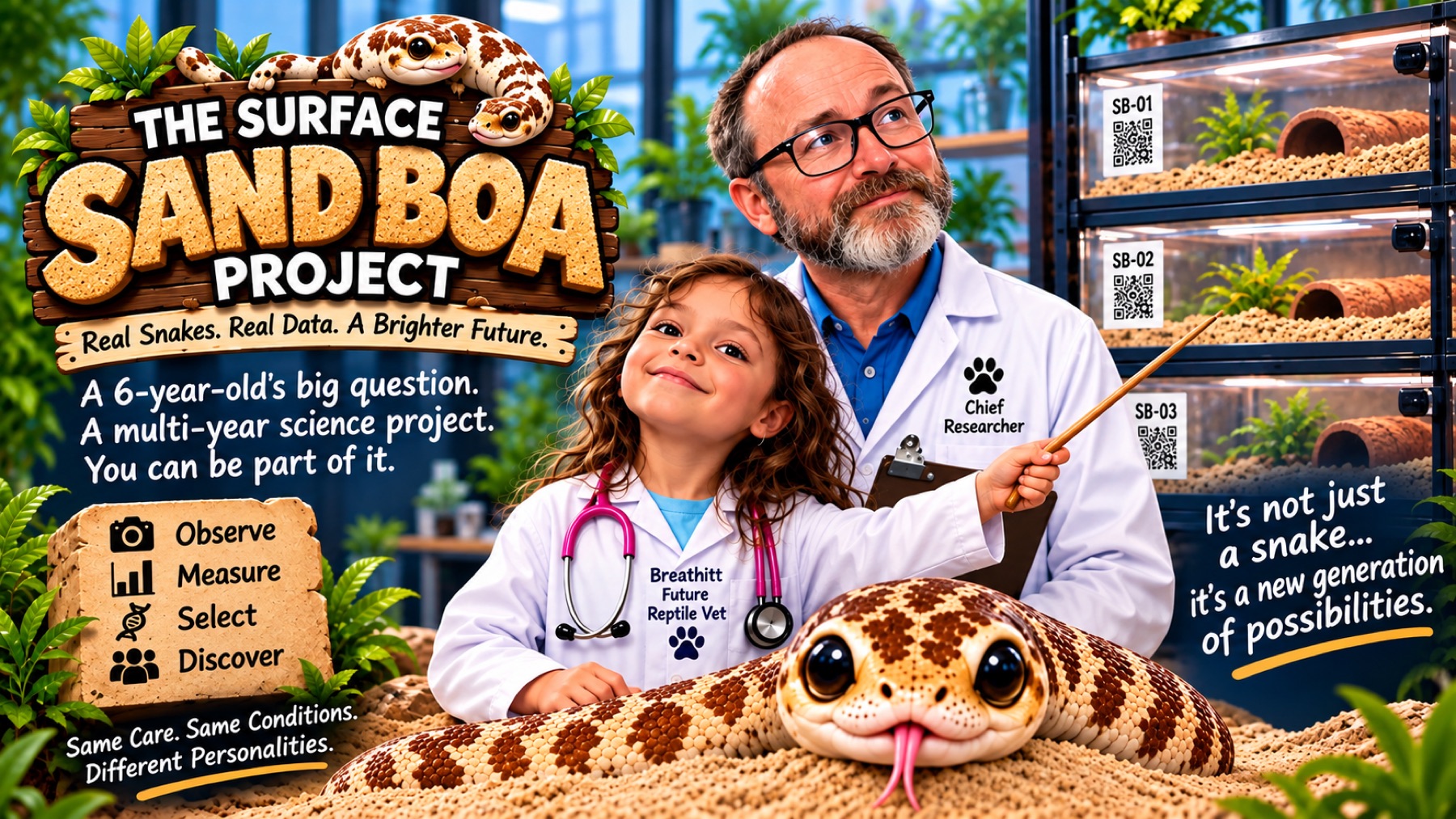
The Surface Sand Boa Project
A multi-year, real-world science project exploring whether selective breeding can produce Kenyan sand boas that voluntarily spend more time above ground.
It’s not just a snake. It’s a new generation of possibilities.
Most Kenyan sand boas are very good at doing exactly what their name suggests: disappearing into the sand.
That is normal, healthy behavior for the species. But individual animals are not identical.
Some emerge more often. Some remain above the substrate longer. Some explore. Some seem far less interested in disappearing than others.
Our question is simple:
If we carefully measure those differences and selectively breed the most consistently surface-active animals, will their descendants become more surface-active too?
We do not know. That is why this project exists.
Observe. Measure. Select. Discover.
Observe
Continuous and repeated behavioral observation.
Measure
Turn impressions into objective records.
Select
Choose breeding candidates based on repeatable behavior, health, and genetic diversity.
Discover
Follow the results across generations — including results that do not support our hypothesis.
Same Care. Same Conditions. Different Personalities.
The animals will not be prevented from burrowing.
Every study animal will have enough substrate to completely disappear if it chooses.
We are not trying to force a sand boa to stay visible.
We are looking for the individuals that have every reasonable opportunity to hide — and repeatedly choose not to.
Current Status
- Study population
- Planned: approximately 20 Kenyan sand boas
- Source diversity
- Target: approximately 10 independent breeders or bloodlines
- Observation system
- In development
- Behavioral data
- Not yet collecting formal study data
- Current generation
- F0 — Founding Population
Where the Project Lives
Live Cams
Watch the observation system when study cameras go live.
Founders Coming SoonMeet the Snakes
Follow every project animal from acquisition through future generations.
Not Yet CollectingReal Data
Explore the measurements once formal observation begins.
Start HereThe Project
Understand the question, design, and long-term plan.
Open ProtocolMethods
See how the study will be conducted and reproduced.
Building in PublicLab Notes
Follow the setup, changes, mistakes, and milestones.
Built Now. Filled In As It Happens.
The pages exist before the data does. That is deliberate — you can watch each one fill in as the project reaches it.
Live Cameras
Watch the observation rack once the study animals are installed and cameras are active.
Animal Profiles
Every snake gets a permanent ID, QR-linked profile, photos, husbandry history, weights, lineage, and behavioral record.
Real Data
Surface activity, emergence events, reburial latency, growth, feeding records, environmental context, and generational comparisons.
Methods
Our study protocol will be public so people can understand exactly how the project works.
Lab Notes
We will publish changes, failures, redesigns, surprises, and lessons learned as the project develops.
Family Trees
As future generations are produced, descendants will be linked to their parents and original founder lines.
This Is Not a Quick Breeding Project.
The first generation must grow.
Breeding animals must reach appropriate maturity and body condition.
Offspring must then be raised and observed under the same standardized conditions. The process may take many years.
That is part of the point.
We are building the project so that the record can outlast any individual breeding season and eventually show how behavior changes — or does not change — across generations.
Follow the experiment from the very beginning.
No manufactured results. No guaranteed outcome. No pretending we already know the answer.
Just a question, a lot of snakes, a lot of observation, and enough patience to find out.